Legal Text Classification Datasets: How Annotated Clauses Train AI for Contracts and Regulatory Documents
.jpeg)
Legal text classification datasets allow AI systems to categorize contract clauses, identify regulatory topics, and interpret legal language with greater accuracy. This article explores how these datasets are created, what annotation strategies support high-quality classification, and how models use labeled text to perform legal analysis. It examines dataset scope, label design, segmenting strategies, and the difficulty of capturing legal nuance. Readers will gain a detailed understanding of how legal text classification datasets underpin contract analysis, compliance automation, and regulatory intelligence workflows. The article concludes with a practical overview of dataset evaluation and future developments.
- Legal text classification datasets allow AI systems to categorize contract clauses, identify regulatory topics, and interpret legal language with greater accuracy.
- This article explores how these datasets are created, what annotation strategies support high-quality classification, and how models use labeled text to perform legal analysis.
- It examines dataset scope, label design, segmenting strategies, and the difficulty of capturing legal nuance.
- Readers will gain a detailed understanding of how legal text classification datasets underpin contract analysis, compliance automation, and regulatory intelligence workflows.
Understanding Legal Text Classification
Legal text classification refers to the process of assigning categories or labels to segments of legal documents such as clauses, paragraphs, or entire sections. These labels help AI models identify the function, topic, intention, or legal effect of a piece of text. Classification tasks range from determining whether a clause contains an obligation to identifying whether a regulatory passage relates to reporting, privacy, or operational requirements. Legal text classification datasets provide the annotated examples that enable machine learning models to recognize these patterns. Research groups working on legal informatics, such as those participating in international academic repositories, contribute insights into how labeled legal text supports downstream AI tasks. The diversity and precision of annotations within these datasets determine how effectively a model can interpret legal content.
Why Classification Matters for Legal AI
Classification is one of the most common and foundational tasks in legal AI. Nearly all downstream workflows require documents or clauses to be categorized. Tasks such as contract review, policy comparison, legal research, and compliance monitoring rely on classification outputs to structure complex information. High-quality datasets allow models to interpret language that varies by jurisdiction, industry, and drafting style. Because classification decisions often trigger critical business processes, the underlying dataset must reflect consistency, depth, and legal nuance. Models trained on poorly annotated data cannot perform reliably in production environments.
The Relationship Between Text Classification and Clause Structure
Legal text classification frequently involves analyzing clause structure. Clauses contain rights, obligations, definitions, exceptions, and contingencies. Understanding how these elements interact requires precise annotation that identifies the purpose and effect of each segment. Annotators must recognize how subtle variations in language can change a clause’s classification. As legal documents can contain overlapping functions, classification must be guided by detailed instructions that ensure consistent interpretation across annotators.
What Legal Text Classification Datasets Contain
Legal text classification datasets include labeled examples of text drawn from contracts, regulations, policies, case law summaries, and corporate governance documents. Each labeled segment helps the model learn how specific categories correspond to patterns of language, structure, and context.
Clause-Level Labeled Data
Classification datasets often focus on clause-level annotation, where annotators label each clause with categories such as confidentiality, liability, termination, or indemnification. These labels teach models to differentiate between common legal functions. Publicly accessible contract templates, such as those found in legal educational repositories, illustrate clause diversity and help annotators understand typical patterns. Clause-level classification provides granular data that supports fine-tuned contract analysis models.
Document-Level Categories
Some datasets classify entire documents by topic, purpose, or jurisdiction. For regulatory compliance tasks, documents may be labeled according to whether they concern reporting requirements, market regulation, consumer protection, or licensing obligations. These broader categories support document routing, indexing, and review processes in large legal operations.
Metadata and Structural Cues
Classification datasets also include metadata such as jurisdiction, document type, or industry. This information helps models differentiate similar clauses that appear in different legal contexts. Metadata support cross-domain generalization and improve model adaptation across varied document sets.
Challenges in Building Legal Text Classification Datasets
Legal text presents unique challenges for classification tasks. It combines formal language, dense logic structures, and domain-specific terminology. Annotators must interpret meaning, intention, and context to provide accurate labels. These challenges require careful guideline design and structured QA protocols.
Ambiguity and Overlapping Categories
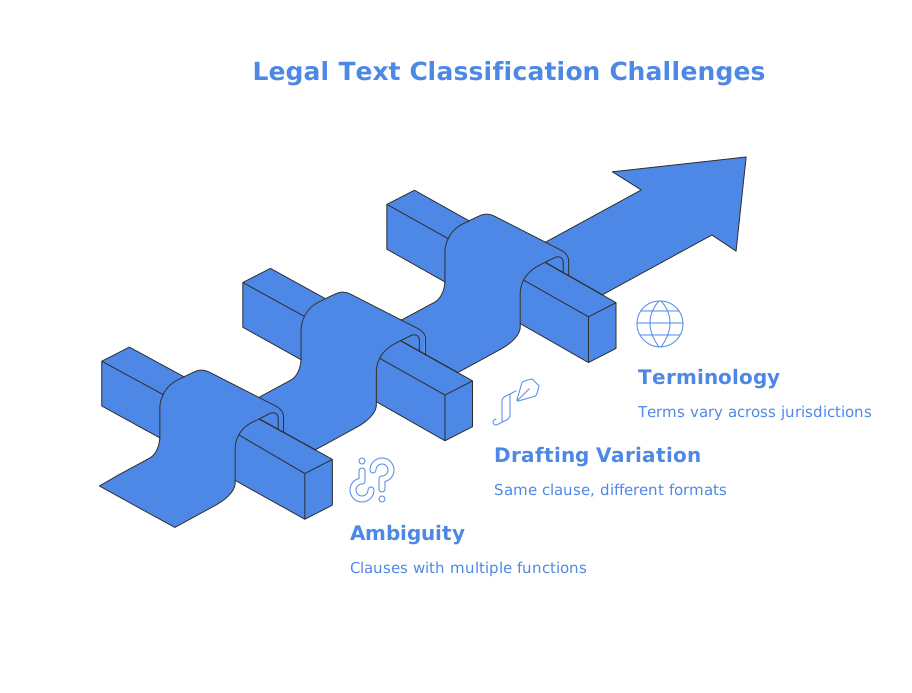
Some clauses contain multiple functions or represent complex multi-step obligations. Annotators must follow clear rules that define when a clause should receive a primary classification or multiple overlapping categories. Without such rules, labels become inconsistent and models struggle to learn reliable patterns.
Variation in Drafting Styles
The same clause type may appear in multiple formats across industries or jurisdictions. A confidentiality clause in a technology services contract may be short and direct, while one in a pharmaceutical manufacturing agreement may be detailed and multi-layered. Annotators must recognize these variations and ensure stable category assignments.
Domain-Specific Terminology
Legal terminology can vary depending on jurisdiction or legal tradition. Annotators must understand the meaning behind specific terms to classify them correctly. Research centers focusing on international legal systems, such as the Max Planck Institute’s rule-of-law publications, illustrate how legal terminology shifts across regions and contexts.
Designing Annotation Guidelines for Legal Classification
Annotation guidelines determine how effectively annotators can label legal text. These guidelines must be detailed, domain-specific, and equipped with examples that demonstrate proper classification. They must define how to treat ambiguous cases, mixed clauses, or overlapping legal functions.
Defining Classification Categories
Categories should align with the intended use of the dataset. For contracts, categories may include indemnification, confidentiality, representations and warranties, governing law, or payment terms. For regulatory documents, categories may include reporting requirements, procedural steps, or compliance obligations. Guideline definitions must include clear explanations and sample clauses to ensure consistent labeling.
Contextual Annotation Instructions
Guidelines should instruct annotators to consider context rather than labeling text strictly by keywords. Legal clauses often contain complex patterns of reasoning that cannot be captured through keyword matching. Annotation strategies may require annotators to read surrounding paragraphs to ensure accurate classification. This reduces the likelihood of mislabeling multi-functional clauses.
How AI Models Learn From Classification Datasets
AI models trained on classification datasets use supervised learning to associate text segments with their correct labels. These models rely on annotated examples to learn syntactic, semantic, and contextual cues. Classification models form the backbone of contract review systems, regulatory compliance automation tools, and legal search platforms.
Learning Semantic Patterns
Models learn how legal concepts are expressed through specific patterns of language. They identify how obligations differ from permissions or restrictions, and how exceptions alter clause meaning. These semantic cues help models interpret clauses robustly across different document types.
Interpreting Document Structure
Legal documents contain structures that guide interpretation. Models learn to recognize headings, subsections, enumerations, and cross-references. Structural cues provide context that helps classification models differentiate between sections that share similar language but serve distinct purposes.
Evaluating Legal Text Classification Datasets
Evaluating a classification dataset involves analyzing annotation consistency, category balance, and representational coverage. Evaluators examine how well the dataset reflects real-world legal documents and whether the labels align with classification goals.
Measuring Annotation Consistency
Annotation consistency is essential for reliable model training. Reviewers compare labels across annotators to identify inconsistencies or disagreements. Calibration sessions help align annotator interpretations with guideline standards. Academic research in annotation reliability emphasizes how consistency directly influences downstream model accuracy.
Ensuring Category Coverage
Datasets must contain enough examples from each category to train effective models. Imbalanced datasets skew model performance and weaken classification accuracy for less frequent categories. Evaluators analyze category distribution and adjust sampling strategies accordingly.
Applications of Legal Text Classification Datasets
Legal text classification datasets support a wide range of practical applications across law, governance, and enterprise legal operations. These applications require consistent, high-quality labels that reflect complex legal reasoning.
Contract Review and Clause Identification
Classification models identify clause types and categorize them for automated review workflows. This supports contract negotiation, compliance checks, and risk assessment. Accurate classification reduces manual review time and improves contract lifecycle management processes.
Regulatory Document Analysis
Classification helps organizations interpret regulatory documents by identifying relevant topics, compliance themes, and procedural steps. This supports regulatory monitoring, policy comparison, and impact assessment tasks. AI-driven classification improves the speed and accuracy of compliance research.
Future Directions in Legal Text Classification Datasets
Legal text classification will evolve as models incorporate more sophisticated representations of language and context. Future datasets will integrate multimodal signals, continuous updates, and assisted annotation methods.
Continuous Dataset Expansion
Legal systems evolve through legislative updates, regulatory revisions, and new contractual frameworks. Classification datasets must be updated continuously to reflect these changes. Ongoing dataset maintenance ensures that classification models remain aligned with current legal standards.
Assisted Annotation and Hybrid Workflows
Machine-assisted annotation tools can accelerate dataset creation by generating preliminary label suggestions. Human annotators refine these suggestions, ensuring domain accuracy while benefiting from increased efficiency. This hybrid workflow supports large-scale dataset creation without compromising quality.
If You Are Building Legal AI Classification Models
Developing reliable classification systems requires high-quality annotated datasets that reflect the structure and complexity of real legal documents. If you are designing datasets for clause classification, regulatory interpretation, or contract analysis, the DataVLab team can help structure and manage annotation workflows that improve model accuracy. Share your objectives, and we can explore how to strengthen your legal AI initiatives with precisely labeled training data.
What are Legal text classification datasets?
Legal text classification datasets allow AI systems to categorize contract clauses, identify regulatory topics, and interpret legal language with greater accuracy. This article explores how these datasets are created, what annotation strategies support high-quality classification, and how models use labeled text to perform legal analysis.
What does the article explain about what legal text classification datasets contain?
Legal text classification datasets include labeled examples of text drawn from contracts, regulations, policies, case law summaries, and corporate governance documents. Each labeled segment helps the model learn how specific categories correspond to patterns of language, structure, and context.
What are the main challenges of Legal text classification datasets?
Legal text presents unique challenges for classification tasks. It combines formal language, dense logic structures, and domain-specific terminology. Annotators must interpret meaning, intention, and context to provide accurate labels.
What is involved in designing annotation guidelines for legal classification?
Annotation guidelines determine how effectively annotators can label legal text. These guidelines must be detailed, domain-specific, and equipped with examples that demonstrate proper classification. They must define how to treat ambiguous cases, mixed clauses, or overlapping legal functions.
What does the article explain about how AI models learn from classification datasets?
AI models trained on classification datasets use supervised learning to associate text segments with their correct labels. These models rely on annotated examples to learn syntactic, semantic, and contextual cues. Classification models form the backbone of contract review systems, regulatory compliance automation tools, and legal search platforms.
What is the future of Legal text classification datasets?
Legal text classification will evolve as models incorporate more sophisticated representations of language and context. Future datasets will integrate multimodal signals, continuous updates, and assisted annotation methods. Legal systems evolve through legislative updates, regulatory revisions, and new contractual frameworks.