From Annotation to Deployment: Closing the Loop with Model Feedback and Active Learning
.jpeg)

In AI development, the journey doesn't end with data annotation—it starts there. This article explores the critical phase of closing the loop between annotation and deployment through model feedback and active learning. These strategies not only improve model accuracy but also cut costs, accelerate time-to-market, and make annotation teams more efficient. From identifying edge cases to retraining loops, we walk you through how top AI teams are turning raw data into smart, responsive systems by continuously integrating feedback from the field. Whether you're building models for computer vision, NLP, or document intelligence, this guide will help you level up your annotation workflow by embracing iterative intelligence.
- In AI development, the journey doesn't end with data annotation—it starts there.
- This article explores the critical phase of closing the loop between annotation and deployment through model feedback and active learning.
- These strategies not only improve model accuracy but also cut costs, accelerate time-to-market, and make annotation teams more efficient.
- Closing the annotation-deployment loop requires more than just occasional retraining—it demands a systematic, automated feedback pipeline that ties model performance directly back to the data source.
Why Closing the Loop Matters in AI Development 🧠
AI development is rarely linear. It’s iterative, data-hungry, and always evolving. Many teams focus heavily on building and training initial models, but what separates a prototype from a production-ready system is how feedback from real-world usage flows back into the dataset.
Closing the loop means enabling a cyclical process where:
- Model errors inform the next batch of annotations
- Human annotators focus on the most valuable data
- AI systems grow smarter with each iteration
Without this loop, models stagnate. They fail in unpredictable environments, especially when exposed to rare events or domain shifts. Active learning and feedback loops aren’t just “nice to have”—they’re a critical strategy for building scalable, accurate AI systems.
What Is Model Feedback in the Annotation Lifecycle?
Model feedback refers to the continuous flow of performance data and prediction outcomes from your deployed AI model back into your training and annotation pipeline. Rather than treating annotation as a one-time task, model feedback turns your dataset into a living resource, constantly evolving in response to how the model performs in real-world conditions.
This feedback mechanism is especially important in dynamic or high-risk domains—like Autonomous Driving, Healthcare diagnostics, or financial document processing—where even minor prediction errors can lead to costly outcomes.
How Does Model Feedback Work?
After a model is deployed (whether in production or in beta testing), it generates valuable outputs such as:
- Prediction confidence scores: Metrics that indicate how certain the model is about a prediction.
- Error logs and user interactions: Including false positives/negatives, corrections by human reviewers, and end-user flags.
- Performance drift indicators: Highlighting when model accuracy declines due to new, previously unseen data distributions.
- Unlabeled data triggers: New data points that the model is unable to classify confidently—ideal candidates for annotation.
These signals can be collected through logging systems, APIs, or integrated dashboards. Once gathered, the feedback is used to identify weaknesses, prioritize re-annotation, or guide additional data collection.
Why Model Feedback Is Critical
- ✅ Reduces annotation waste by pinpointing exactly where labeling effort should go.
- 🧠 Improves model generalization by introducing real-world edge cases into the training loop.
- 🔍 Uncovers systematic bias or blind spots, helping teams fine-tune taxonomies and detection rules.
- 📈 Accelerates iteration cycles by replacing guesswork with data-driven retraining priorities.
Instead of blindly labeling more data, you’re training your models based on what actually matters. This is especially powerful when paired with human-in-the-loop review, where annotators help interpret ambiguous model outputs.
For example, if a computer vision model flags a batch of blurry images with low confidence, your team can review and annotate only those—rather than the entire image stream—making the process efficient and laser-focused.
Explore tools like V7 Darwin and FiftyOne that provide deep insights into model predictions and simplify feedback loop management.
The Role of Active Learning in Reducing Labeling Waste ✂️
Traditional annotation often means labeling hundreds of thousands of images or documents up front—many of which may contribute little to the final model’s performance. Active learning flips that paradigm by allowing the model to “ask” for labels where it’s most unsure or where the data distribution is underrepresented.
Instead of labeling everything, you label strategically.
Common active learning strategies:
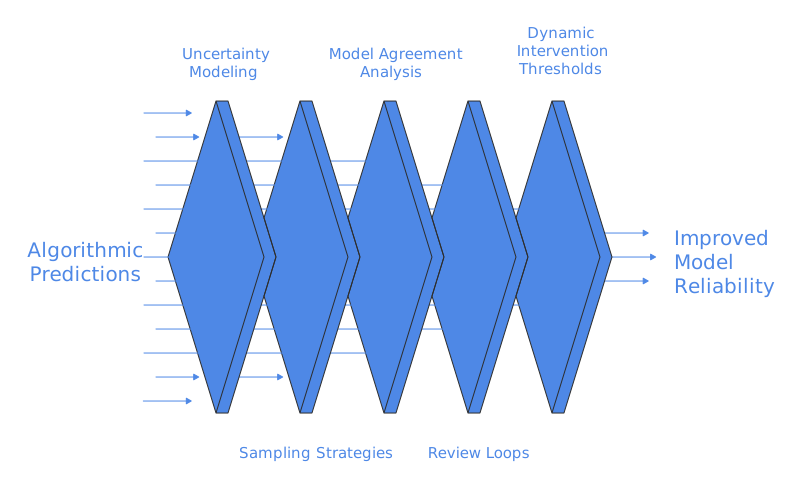
- Uncertainty sampling: Prioritize samples with low prediction confidence.
- Diversity sampling: Select examples that add new patterns to the dataset.
- Query-by-committee: Compare outputs of multiple model variants and focus on disagreement.
- Entropy-based sampling: Use entropy metrics to prioritize complex or ambiguous inputs.
In practice, active learning can reduce labeling costs by 50–80% while improving model generalization, especially in domains like:
- Satellite image analysis
- Medical imaging
- Industrial inspection
- Document OCR
See this NVIDIA blog for real-world applications of active learning with large-scale visual datasets.
Integrating the Feedback Loop in Your AI Pipeline 🔄
Closing the annotation-deployment loop requires more than just occasional retraining—it demands a systematic, automated feedback pipeline that ties model performance directly back to the data source. This enables incremental learning, where every real-world insight becomes fuel for improvement.
Here’s how to architect a high-impact feedback loop within your AI development lifecycle:
1. Build with Feedback in Mind
From the start, design your infrastructure to:
- Log predictions (with metadata)
- Store raw inputs securely
- Tag samples for future annotation
- Monitor performance by task, class, and region
Use frameworks like MLflow or ClearML to integrate training logs, model metadata, and experiment tracking into your feedback pipeline.
2. Define Feedback Triggers 🧲
Not all data needs to go back into the loop. Set up smart triggers to capture high-value samples:
- Low-confidence predictions (e.g. <50% confidence)
- Disagreements between ensemble models
- Outliers in feature space (via clustering)
- Explicit user corrections or “report a problem” flags
- Concept drift indicators (e.g. sudden performance drops)
These triggers can generate candidate batches that go straight into your annotation queue for review or re-labeling.
3. Enable Bi-Directional Flow Between Model and Annotators
Integrate your model outputs directly with your annotation platform. For example:
- Push failed predictions to Label Studio or Encord as pre-labeled suggestions.
- Add confidence visualizations in the annotation UI.
- Let annotators see model errors and override or approve them with comments.
This interaction creates a tight loop between model errors and human correction—essential for domains like medical AI or compliance workflows.
4. Automate the Loop: From Inference to Re-Training 🤖
Don’t rely on manual steps to move data through the pipeline. Instead, automate the loop using:
- Scheduled model evaluations on new data
- Edge functions or webhooks to stream errors into annotation queues
- Batch retraining jobs triggered by annotation completions
- Version control for datasets to track what changed and why
With automation in place, you can trigger retraining every week, every day—or even continuously if your application requires it.
5. Monitor Performance Improvements Across Iterations 📊
Every iteration should improve performance. Use dashboards that track metrics like:
- Per-class accuracy
- Reduction in false positives
- Speed of annotation cycle
- Annotation cost vs. model lift
Compare model versions side-by-side using tools like Comet ML or Weights & Biases, and make retraining decisions based on data—not intuition.
6. Optimize for Scale and Latency
As your system scales, prioritize:
- Labeling throughput: Use semi-automated pre-labeling with human review.
- Latency: Optimize retraining times with smaller, targeted datasets.
- Cost management: Use active learning to label only the most informative samples.
If done well, your feedback loop becomes a perpetual motion machine—constantly improving your models without ballooning costs or timelines.
Human-in-the-Loop (HITL): Not Optional, But Essential 🤝
No matter how advanced your model, it will always need human help—especially when encountering edge cases, ambiguity, or subjective labels. HITL systems ensure that human annotators remain an active part of the feedback cycle.
Ways humans contribute in a feedback loop:
- Validating AI-generated predictions
- Spotting errors or mislabeled data
- Providing context-rich annotations that models can’t infer
- Re-labeling based on new taxonomies or business logic changes
Importantly, model feedback can help prioritize annotator attention, letting them focus on impactful corrections instead of re-labeling everything.
Common Pitfalls in Feedback Loops (and How to Avoid Them) ⚠️
While model feedback loops and active learning are powerful, they can also go wrong. Here are common challenges and how to address them:
- Feedback latency: Delays between data collection and model update slow progress.
➤ Use automation to pipeline retraining and re-deployment. - Biased sampling: Over-sampling difficult cases may skew the training distribution.
➤ Balance uncertain data with representative samples. - Poor error analysis: Failing to understand why the model failed limits correction.
➤ Use visualization tools to dig deep into class-wise and sample-wise performance. - Too much trust in the model: Auto-labeling based on weak predictions introduces error.
➤ Always validate with human review in critical loops. - Non-scalable annotation workflows: If your annotation workflow can’t grow with your data, you’ll bottleneck.
➤ Invest in tools that support collaborative review and bulk labeling with AI assistance.
Real-World Use Cases That Prove the Power of the Loop 🔍
Autonomous Vehicles
Companies like Waymo and Tesla use continuous feedback loops from on-road performance. After deployment, systems flag rare events—like a pedestrian jaywalking or an unusual vehicle shape—and send them back for annotation and model improvement.
Medical AI
Radiology tools retrain on edge cases flagged during clinical review. For example, if a model misidentifies a small tumor on an unusual scan, it can trigger annotation feedback, retraining, and verification—all within a HIPAA-compliant workflow.
Satellite Imagery
In geospatial applications, active learning helps prioritize the labeling of cloud-covered or seasonally unique images that models struggle with, improving object detection across terrains.
Retail & Checkout AI
Amazon Go-style systems use customer behavior and camera feeds to correct checkout errors. Misidentified items or ambiguous gestures are flagged, annotated, and retrained into the model, closing the loop fast—sometimes within hours.
How to Kickstart Your Feedback-Driven Workflow 🚀
Ready to start closing the loop? Here’s a pragmatic approach to get going—even with a small team:
Step 1: Deploy your model early
Even if it's imperfect, a model in the real world generates valuable feedback that no test set can match.
Step 2: Set up prediction logging
Record every prediction, confidence score, and error. Bonus: flag events with high user impact.
Step 3: Define feedback triggers
Decide what qualifies as a sample worth re-annotating—low confidence, false positive, etc.
Step 4: Loop in your annotation team
Ensure your labelers know why a sample is being reviewed. Feedback context helps quality.
Step 5: Automate your active learning cycles
Use cron jobs, pipelines, or tools like Snorkel Flow to automate the selection, labeling, and retraining process.
Looking Ahead: The Future of Feedback-Driven AI 🧬
We’re entering a phase where annotation and modeling are becoming inseparable. As models get embedded into dynamic environments—factories, hospitals, cities—they must constantly evolve.
Emerging trends to watch:
- Self-supervised feedback loops using foundation models
- Federated active learning across distributed systems
- Synthetic sample injection for rare edge cases
- AI co-pilots for annotation that guide humans through review tasks
The endgame? A world where annotation isn’t just the starting point of AI—but an always-on mechanism for learning, adapting, and improving in the wild.
Let’s Make Your Data Work Smarter, Not Harder 💡
If you're still treating annotation and deployment as disconnected steps, you're leaving value on the table. Feedback loops and active learning don’t just build better models—they build more resilient teams and faster iteration cycles.
Whether you're scaling up a vision system, refining NLP models, or annotating complex documents, it’s time to rethink your workflow. Start small, integrate feedback, and let your model tell you what it needs next.
Curious how this could apply to your pipeline? Let’s brainstorm together and design an adaptive annotation strategy that actually scales. Reach out to our team at DataVLab and close the loop for good. ✅
What is From annotation to deployment?
In AI development, the journey doesn't end with data annotation—it starts there. This article explores the critical phase of closing the loop between annotation and deployment through model feedback and active learning. These strategies not only improve model accuracy but also cut costs, accelerate time-to-market, and make annotation teams more efficient.
Why does closing the loop matter in AI development?
Many teams focus heavily on building and training initial models, but what separates a prototype from a production-ready system is how feedback from real-world usage flows back into the dataset. Model errors inform the next batch of annotations.
What is model feedback in the annotation lifecycle?
This feedback mechanism is especially important in dynamic or high-risk domains—like Autonomous Driving, Healthcare diagnostics, or financial document processing—where even minor prediction errors can lead to costly outcomes. Prediction confidence scores: Metrics that indicate how certain the model is about a prediction.
What are the main challenges of From annotation to deployment?
While model feedback loops and active learning are powerful, they can also go wrong. Feedback latency: Delays between data collection and model update slow progress.➤ Use automation to pipeline retraining and re-deployment. Biased sampling: Over-sampling difficult cases may skew the training distribution.➤ Balance uncertain data with representative samples.
What are the main use cases for From annotation to deployment?
Companies like Waymo and Tesla use continuous feedback loops from on-road performance. After deployment, systems flag rare events—like a pedestrian jaywalking or an unusual vehicle shape—and send them back for annotation and model improvement. Radiology tools retrain on edge cases flagged during clinical review.
What does the article explain about how to kickstart your Feedback-Driven workflow?
Even if it's imperfect, a model in the real world generates valuable feedback that no test set can match. Decide what qualifies as a sample worth re-annotating—low confidence, false positive, etc. Use cron jobs, pipelines, or tools like Snorkel Flow to automate the selection, labeling, and retraining process.