Assessing Property Condition with AI: How Labeled Images Power Automated Inspections
.jpeg)
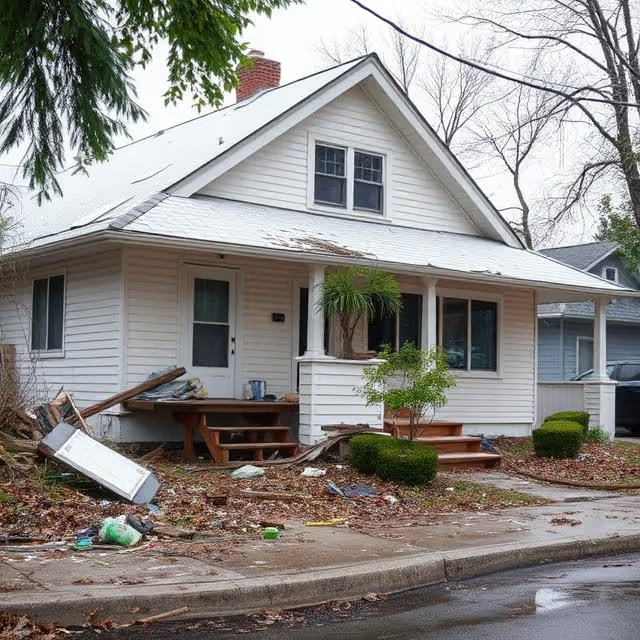
AI is reshaping how we evaluate property conditions—from pinpointing cracked walls to identifying water damage and wear on rooftops. At the core of this transformation lies labeled image data, which enables machine learning models to automate property inspections with remarkable accuracy and scale. This article dives deep into how AI systems trained on annotated images are revolutionizing property condition assessments in real estate, insurance, and facilities management. You'll gain insights into data strategies, model performance, industry use cases, and quality assurance techniques, all without getting lost in tech jargon. Whether you're a real estate tech startup, an insurance provider, or a property manager exploring automation, this guide will help you understand the power of visual data annotation for AI-led inspections.
- AI is reshaping how we evaluate property conditions—from pinpointing cracked walls to identifying water damage and wear on rooftops.
- At the core of this transformation lies labeled image data, which enables machine learning models to automate property inspections with remarkable accuracy and scale.
- This article dives deep into how AI systems trained on annotated images are revolutionizing property condition assessments in real estate, insurance, and facilities management.
- This labeled data teaches AI models to detect, classify, and even quantify the severity of damage or degradation from visual input.
Why Property Condition Assessment Needs Reinventing
Manual property inspections are costly, slow, and prone to human error. Whether it’s for real estate valuation, home insurance claims, or rental turnover documentation, the traditional approach involves inspectors manually checking structural integrity, capturing photos, and filling out reports. This process is often inconsistent, especially when scaled across geographies or managed by multiple contractors.
With the rise of PropTech and InsurTech, there’s a growing demand for more scalable, objective, and real-time assessment methods. That’s where computer vision steps in—powered by thousands of accurately labeled property images.
How Labeled Images Fuel AI for Condition Assessment
Labeled images are the foundation of training any vision-based AI system. In the context of property condition evaluation, labeled datasets typically include photos of building interiors and exteriors tagged with attributes such as:
- Wall cracks (minor, structural)
- Roof discoloration or sagging
- Mold or water stains
- Window damage
- Paint deterioration
- Foundation irregularities
- HVAC unit condition
- Flooring scratches or buckling
This labeled data teaches AI models to detect, classify, and even quantify the severity of damage or degradation from visual input. Over time, models become increasingly accurate as they’re exposed to diverse property types, architectural styles, lighting conditions, and image qualities.
Key Use Cases in Real Estate and Insurance
Rental Property Turnover and Maintenance
Property management companies use AI to automatically inspect rental units after tenant move-outs. By comparing annotated pre- and post-occupancy images, the system can flag changes such as carpet wear, broken tiles, or wall damage—saving hours of manual inspection per unit.
Insurance Claims Automation
Insurance providers like Lemonade and Hippo are leveraging AI to validate home insurance claims. By comparing uploaded user images with baseline condition datasets, AI systems can assess the extent of new damage, reducing claim fraud and speeding up processing.
👉 Example: After a storm, a policyholder uploads exterior photos. The AI detects hail-induced roof dents and cross-checks with historical imagery, estimating damage severity and recommending repair cost brackets.
Pre-Purchase and Mortgage Inspections
Mortgage lenders and real estate platforms are incorporating AI into digital home assessments. For instance, if a buyer requests a property appraisal, AI can automatically identify structural issues and flag them for further review, often ahead of in-person inspections.
Facility Condition Indexing at Scale
Institutions managing thousands of buildings—like school districts or government facilities—need scalable ways to monitor wear and tear. AI-powered condition indexing can analyze image archives and update maintenance logs, alerting teams to degrading infrastructure.
What Makes an Image Annotation Dataset “Inspection-Ready”?
Creating training datasets that truly reflect real-world property issues requires thoughtful planning. Here’s what makes a labeled dataset effective for AI-driven inspection:
Diversity of Properties
To generalize well, datasets must cover a wide variety of building types—urban apartments, rural homes, historic buildings, commercial structures—across different climates and regions.
Damage Severity Levels
It’s critical to differentiate between superficial wear (e.g., chipped paint) and structural issues (e.g., foundational cracks). Labels should include severity tags or numerical risk scores for better model inference.
Contextual Tags
Labels should consider context, such as whether a window crack is on a ground-floor pane or an attic skylight. The AI’s interpretation may differ depending on where the damage occurs.
Temporal Image Pairs
Including before-and-after image sequences helps AI understand how damage evolves, which is especially valuable for post-disaster recovery models or predictive maintenance platforms.
The Role of AI Models in Inspection Automation
Trained AI models can now classify damage, detect anomalies, and even generate inspection reports. Here’s how it typically works:
- Input: A batch of photos taken by a smartphone, drone, or site scanner
- Processing: The AI uses convolutional neural networks (CNNs) to detect patterns associated with common types of property degradation
- Output: Condition summaries, issue tags (e.g., “roof sagging”), and severity scores
Advanced systems even include heatmaps to visualize damage hotspots across buildings, offering inspectors a fast overview of priority issues.
Popular models used in property condition assessment include YOLOv8 for object detection and segmentation, and ViTs (Vision Transformers) for nuanced image classification.
Integrating AI with Property Management Workflows
For AI inspection tools to be effective, they must integrate into existing property workflows. This often means building or adapting platforms that:
- Sync with property management systems (PMS)
- Offer mobile apps for tenant or inspector image uploads
- Provide inspection dashboards with visual analytics
- Automatically generate inspection reports in PDF or JSON formats
Supabase, Lovable.dev, and tools like Retool or Appsmith are often used by PropTech startups to prototype such workflows quickly and securely.
Addressing Trust, Accuracy, and Compliance
Accuracy is paramount when property conditions affect purchase decisions or insurance outcomes. Here’s how AI developers and data teams ensure reliability:
Cross-Validation with Human Review
Many models incorporate human-in-the-loop verification. Annotations flagged by AI can be routed to expert reviewers, who validate predictions and help refine the model with corrected labels.
Confidence Scoring and Thresholding
AI outputs are often paired with confidence scores (e.g., “wall crack detected, 92% confidence”), allowing platforms to filter or flag uncertain predictions for further inspection.
Compliance with Standards
For institutional use, systems must comply with standards like the International Property Maintenance Code (IPMC) or insurer-specific underwriting criteria. This requires precise labeling, detailed audit logs, and reproducible inspection outputs.
Overcoming Challenges in Visual Property Assessment
Despite rapid advancements, AI-based inspections face unique challenges:
- Lighting Variations: Shadows and reflections can confuse models
- Obstructions: Furniture or vegetation can obscure structural damage
- Image Quality: Blurry or low-resolution photos reduce detection accuracy
- Subjectivity: “Wear and tear” is often judged differently by stakeholders
These challenges are addressed by training with diverse data, using synthetic augmentation (e.g., shadow simulation), and continuously updating the dataset as new edge cases emerge.
Scaling AI Inspections Across Geographies
Localization plays a big role. A crack in a home in Los Angeles may not signal the same urgency as in Tokyo due to seismic norms. That’s why multinational datasets and region-specific training are vital.
Tech platforms expanding across markets often collaborate with local Data Labeling teams or use crowdsourcing platforms to scale annotations efficiently while keeping cultural and architectural variations in check.
Future Trends in Automated Property Condition Monitoring
The next wave of innovation will likely focus on:
- 3D property scans using LiDAR or photogrammetry paired with AI
- Predictive maintenance through longitudinal image analysis
- Voice-assisted inspections where inspectors narrate findings, synced with visual data
- Blockchain-backed condition records for immutable documentation
Also on the rise are edge AI tools embedded in smart cameras or inspection drones, allowing real-time damage detection even in areas without reliable internet connectivity.
Let’s Bring Intelligence to Every Inspection 🧠🏘️
The fusion of labeled images and AI is revolutionizing how we assess properties—cutting costs, saving time, and reducing subjectivity. But the key ingredient remains high-quality, well-labeled image data. Whether you're a PropTech founder, real estate investor, or insurer, tapping into this new frontier requires the right data strategy and the right partners.
If you’re exploring how to integrate automated inspections into your business or want expert support with labeled property datasets, now’s the perfect time to start. Let's build smarter, faster, and more scalable inspections—together.
👉 Reach out to explore how annotated imagery can power your property AI solutions.
What is Assessing property condition with AI?
AI is reshaping how we evaluate property conditions—from pinpointing cracked walls to identifying water damage and wear on rooftops. At the core of this transformation lies labeled image data, which enables machine learning models to automate property inspections with remarkable accuracy and scale.
What does the article explain about why property condition assessment needs reinventing?
Manual property inspections are costly, slow, and prone to human error. Whether it’s for real estate valuation, home insurance claims, or rental turnover documentation, the traditional approach involves inspectors manually checking structural integrity, capturing photos, and filling out reports.
What makes an image annotation dataset “Inspection-Ready”?
Creating training datasets that truly reflect real-world property issues requires thoughtful planning. To generalize well, datasets must cover a wide variety of building types—urban apartments, rural homes, historic buildings, commercial structures—across different climates and regions. It’s critical to differentiate between superficial wear (e.g., chipped paint) and structural issues (e.g., foundational cracks).
What is involved in integrating AI with property management workflows?
For AI inspection tools to be effective, they must integrate into existing property workflows. Offer mobile apps for tenant or inspector image uploads. Automatically generate inspection reports in PDF or JSON formats.
What are the main challenges of Assessing property condition with AI?
Lighting Variations: Shadows and reflections can confuse models. Obstructions: Furniture or vegetation can obscure structural damage. Image Quality: Blurry or low-resolution photos reduce detection accuracy.
What is the future of Assessing property condition with AI?
3D property scans using LiDAR or photogrammetry paired with AI. Voice-assisted inspections where inspectors narrate findings, synced with visual data. Also on the rise are edge AI tools embedded in smart cameras or inspection drones, allowing real-time damage detection even in areas without reliable internet connectivity.