Insurance Fraud Dataset : How Multimodal AI Detects Claims Fraud Across Images, Documents, and Structured Data
.jpeg)

Insurance fraud datasets are becoming essential for training modern AI systems that detect forged photos, manipulated documents, staged accidents, and suspicious claims patterns. Because insurance fraud increasingly spans visual evidence, written records, and structured claim histories, the most effective datasets are now multimodal, containing a mix of images, OCR-extracted text, geospatial data, and metadata. This article explores how these datasets are built, which annotation workflows are required, what modalities should be included, and how insurance companies use them for fraud analysis. It also reviews challenges such as synthetic image detection, privacy requirements, model bias, and claim variability across regions. As insurers adopt AI for automating claim verification, high quality insurance fraud datasets are becoming a foundational asset that determines accuracy, reliability, and regulatory compliance.
- Insurance fraud datasets are becoming essential for training modern AI systems that detect forged photos, manipulated documents, staged accidents, and suspicious claims patterns.
- Because insurance fraud increasingly spans visual evidence, written records, and structured claim histories, the most effective datasets are now multimodal, containing a mix of images, OCR-extracted text, geospatial data, and metadata.
- This article explores how these datasets are built, which annotation workflows are required, what modalities should be included, and how insurance companies use them for fraud analysis.
- As insurers adopt AI for automating claim verification, high quality insurance fraud datasets are becoming a foundational asset that determines accuracy, reliability, and regulatory compliance.
Understanding Insurance Fraud Datasets
Insurance fraud datasets are collections of information used to train machine learning systems that detect fraudulent claims. Because fraud takes many forms, these datasets bring together several modalities such as structured transaction logs, claim descriptions, scanned documents, policyholder history, geolocation timestamps, and increasingly, images and videos of alleged damage.
Historically, insurers relied primarily on structured data or manual expert review. Fraud specialists examined patterns, inconsistencies, or unusual spending behavior. Today, fraud has become more sophisticated and more visual. Claims often involve vehicle damage images, property inspection photos, medical documentation, or repair invoices. This shift has pushed insurers to incorporate multimodal AI that analyzes not only numbers and text but also complex visual material. Studies published by the International Association of Insurance Supervisors highlight the growing use of AI tools for visual claims verification and synthetic fraud detection.
Because fraud often hides in small details of images, document metadata, or claim inconsistencies, datasets must capture a wide spectrum of fraud behaviors and authentic examples.
Why Insurance Fraud Datasets Are Becoming Multimodal
Fraud now happens across multiple data sources
Modern fraud does not rely on a single weak point. A fraudulent claim may combine manipulated photos, fabricated documents, false location metadata, and inconsistent narrative descriptions. A robust insurance fraud dataset must therefore represent the full ecosystem of evidence.
Visual evidence is now a core part of claims
Insurers encourage policyholders to submit photos through mobile apps. These images are often used for quick claims processing, but they also open the door to image manipulation or tampering. AI must analyze the authenticity of these images.
Document fraud is rising
Fraudsters frequently upload forged estimates, edited repair receipts, falsified invoices, or manipulated medical documents. OCR based document parsing combined with image forensics is now required.
Structured data alone is insufficient
While structured fraud data flags suspicious behaviors, it does not reveal visual inconsistencies such as repeated backgrounds, tampered EXIF data, unrealistic damage patterns, or reused stock photos.
AI models require real world complexity
Fraud examples vary significantly between countries, industries, and insurance verticals. Datasets must therefore include realistic, diverse samples across property, auto, health, and specialty insurance.
The combination of structured, textual, and visual data creates a more complete training foundation for modern fraud detection models.
Types of Data Found in Insurance Fraud Datasets
Vehicle damage images
Car insurance generates massive volumes of visual data from collision photos, bumper damage, windshield cracks, and body panel deformation. Fraud datasets include examples of staged accidents, digitally edited images, and images from unrelated incidents.
Property damage images
Claims involving home flooding, fire damage, break-ins, or appliance failure rely heavily on visual evidence. Fraud datasets include both genuine and manipulated examples.
Scanned documents and invoices
Repair invoices, medical reports, rental agreements, and receipts can be forged. OCR extracts textual content while models analyze visual irregularities.
Metadata and EXIF data
Timestamp manipulation, GPS inconsistencies, or mismatches between weather metadata and reported events are valuable indicators of fraud.
Audio or call center transcripts
Some fraud cases involve scripted narratives or repeated patterns across multiple callers. NLP tools use transcripts to detect patterns and inconsistencies.
Geospatial and temporal data
Insurers use geolocation data to cross check the validity of reported incidents. Datasets include location coordinates, traffic data, and weather records.
Historical claim behavior
Structured datasets include prior claims, payment history, claim frequency, relationships between parties, and anomaly flags.
Multimodal datasets integrate all these components into a unified dataset for training fraud detection models.
Image Components in Insurance Fraud Datasets
Image data plays a central role in modern insurance fraud datasets. Fraudsters often submit doctored photographs, stock images, or AI generated images to support false claims. Visual fraud detection models must recognize subtle anomalies.
Tampered images
These include edited backgrounds, inserted damage areas, cloned textures, or unrealistic reflections. Models learn to detect manipulation patterns.
Stock image reuse
Fraudsters may reuse publicly available images. Datasets incorporate reference databases to detect duplicates or near duplicates.
Staged damage
Fraudsters stage accidents or exaggerate existing damage. Models compare image patterns against known collision signatures.
Inconsistent shadows or lighting
Computer vision analyzes lighting inconsistencies that reveal synthetic image creation.
AI generated or manipulated content
As generative models evolve, fraudsters use them to create plausible fake damage. Insurance datasets now incorporate synthetic examples to train robustness. Research from the University of Amsterdam’s Computer Vision Lab shows that GAN fingerprints can be detected through pixel-level analysis.
Image evidence requires specialized annotation workflows due to the complexity of fraud-related cues.
Document and OCR Components
Many fraudulent claims involve manipulated documents. Insurance fraud datasets include:
Edited invoices
Fraudsters alter amounts, date stamps, or vendor names.
Fake receipts
Fraud datasets include examples of receipts printed using fraudulent templates or doctored from scanned originals.
Fabricated estimates
Some claimants create or modify repair estimates using tools like Photoshop or mobile editors.
Tampered PDFs
Metadata discrepancies or layered PDF structures may indicate manipulation.
Medical documentation fraud
Fake medical certificates or altered diagnostic records are common in healthcare-related insurance fraud.
OCR systems extract text from these documents while computer vision models analyze formatting, font irregularities, and digital artifacts.
Structured Data Components
While images and documents are important, structured datasets remain a key part of insurance fraud modeling.
Claim-level features
Key timestamps, claim types, payout amounts, and claim duration.
Policyholder behavior
Patterns such as overuse, repeated claims, or inconsistent reporting timelines.
Cross claim correlations
Links between repair shops, adjusters, policyholders, or vehicles.
External data sources
Vehicle records, property valuations, accident history, or supplier verification.
When combined with visual evidence, structured data increases the accuracy of fraud detection systems.
Building an Insurance Fraud Dataset
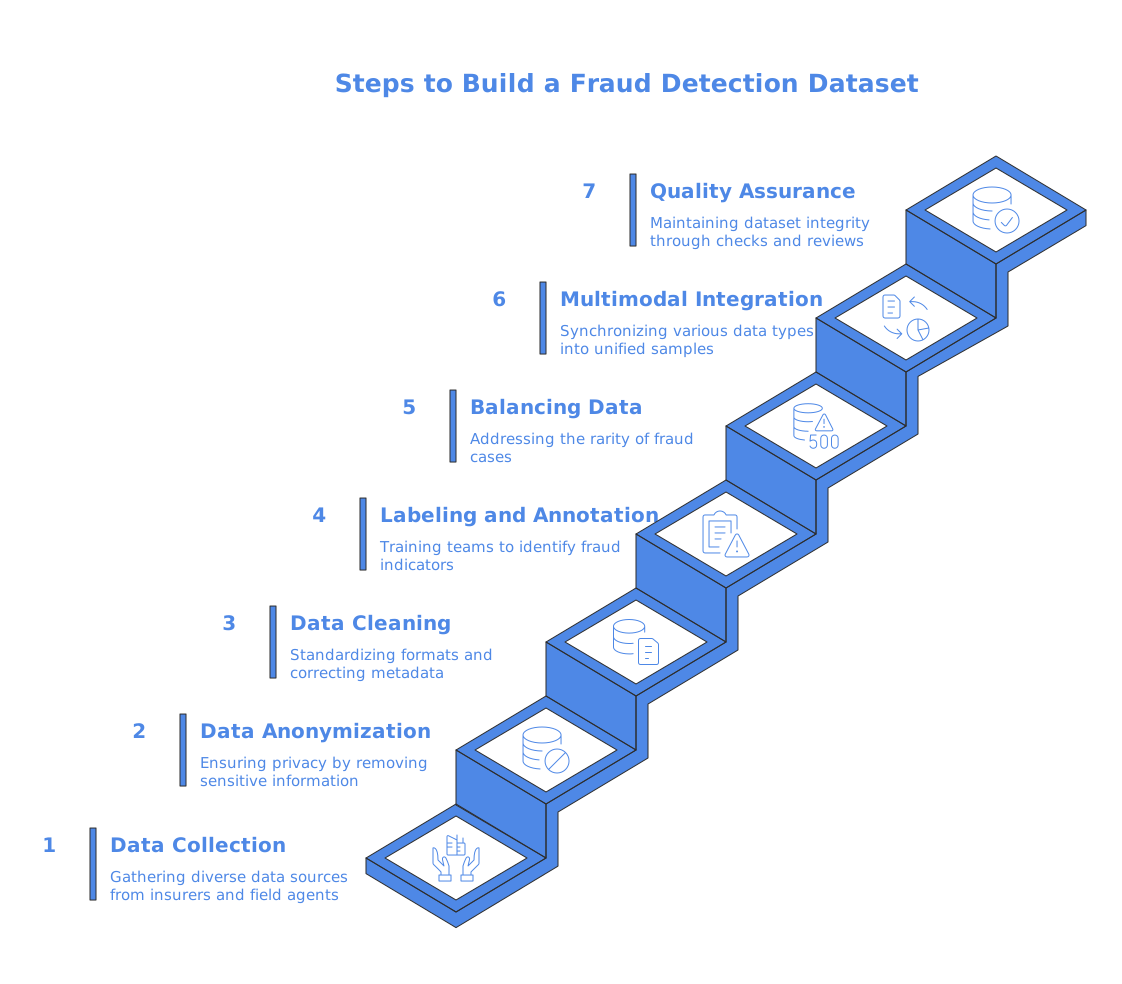
Creating a high quality insurance fraud dataset is a multi stage process that requires significant domain expertise.
Data collection
Insurers gather image evidence, document scans, claim metadata, and policyholder history. Field agents, mobile apps, and repair shops contribute to data streams.
Data anonymization
Because insurance data contains sensitive personal information, anonymization is essential. Faces, license plates, personal addresses, and account identifiers may be blurred or redacted.
Data cleaning
Cleaning involves removing duplicates, standardizing formats, correcting metadata, and ensuring consistent annotation schemas.
Labeling and annotation
Annotation requires skilled teams trained in fraud indicators. The following section explains annotation workflows.
Balancing fraud vs. non fraud examples
Fraud cases are rare. To prevent imbalanced datasets, curated sampling, synthetic augmentation, and anomaly detection techniques are necessary.
Multimodal integration
Datasets must synchronize images, metadata, OCR text, and structured data into unified training samples.
Quality assurance
Consistency checks, cross annotation validation, and expert review maintain dataset integrity.
Building fraud datasets requires specialized workflows due to complexity and regulatory constraints.
Annotation Workflows for Insurance Fraud
Insurance fraud annotation is more nuanced than standard object detection or classification tasks.
Image tampering annotation
Annotators label doctored areas, unnatural textures, cloned regions, or manipulated lighting.
Damage classification
Labels specify whether damage is consistent with a real collision, staged accident, or unrelated event.
Document forgery flags
Annotators highlight mismatched fonts, incorrect formatting, inconsistent alignment, or digital editing marks.
Metadata inconsistency annotation
Fraud specialists annotate mismatches in timestamp, geolocation, sensor data, or EXIF information.
Cross modality linking
Annotators verify whether image content matches claim descriptions or structured metadata.
Semantic segmentation of damage areas
Segmentation masks help models detect authentic vs. suspicious damage regions.
Claim intent classification
Some fraud datasets include labels such as opportunistic, preplanned, inflationary, or organized fraud.
Annotation for insurance fraud requires highly trained annotators capable of identifying subtle cues.
Challenges in Insurance Fraud Dataset Creation
Extreme class imbalance
Fraud cases represent a small fraction of total claims. Training must address imbalance through sampling, augmentation, or anomaly detection.
High variability in fraud types
Fraud schemes evolve, requiring continuous dataset updates to maintain model relevance.
Privacy and compliance constraints
Insurance data involves personal information protected under laws such as GDPR. This limits sharing and dataset publication.
Domain-specific expertise
Annotation requires fraud analysts or trained annotators who understand insurance workflows, damage patterns, and document structures.
Synthetic fraud sophistication
As generative AI improves, fraudsters create more realistic manipulated images. Datasets must evolve to include new fraud types.
Multimodal synchronization
Aligning images, documents, and structured data requires careful metadata management.
Unpredictable contexts
Damage scenes vary widely in lighting, angle, location, and device type. Models must generalize across all conditions.
These challenges highlight the need for specialized dataset creation and annotation partners.
Applications of Insurance Fraud Datasets
Automated claims triage
AI screens incoming claims and flags suspicious cases for further review.
Image tampering detection
Models identify forged or edited damage photos.
Document tampering detection
AI flags edited invoices, fake repair reports, or inconsistent document metadata.
Staged accident identification
Models compare visual patterns to detect unnatural or implausible damage mechanisms.
Duplicate claim detection
AI matches images or documents across historical databases to detect repeated submissions.
Geospatial fraud detection
Claims inconsistent with weather, location, or traffic data are flagged.
Narrative inconsistency detection
NLP models compare textual descriptions to visual evidence.
Customer-level anomaly detection
Behavioral patterns help identify opportunistic or repeated fraudulent behavior.
The most powerful fraud detection systems use multimodal datasets combining all these signals.
How AI Models Use Insurance Fraud Datasets
Computer vision models
Detect tampered regions, assess damage authenticity, and match images across claims.
OCR + NLP models
Analyze documents, extract key information, and detect anomalies in textual patterns.
Hybrid multimodal transformers
Combine image features, text embeddings, and structured data vectors for unified prediction.
Graph neural networks
Model relationships between claimants, repair shops, and claim events.
Anomaly detection models
Identify unusual patterns without requiring labeled fraud examples.
Metadata consistency models
Check whether timestamps, geolocation, or environmental conditions match claim narratives.
AI systems use fraud datasets to learn correlations across modalities and detect subtle anomalies.
Future of Insurance Fraud Datasets
Integration of synthetic fraud examples
Insurers will increasingly generate synthetic tampered images and documents to train more robust models.
Standardized multimodal datasets
Industry collaborations will push toward shared fraud taxonomies and annotation standards.
Real time fraud detection
Models will analyze incoming claims instantly using edge and cloud infrastructure.
AI forensics
Future models will incorporate forensic techniques from digital crime analysis to detect microscopic editing traces.
Cross insurer fraud intelligence
Federated learning will allow insurers to train models collaboratively without sharing sensitive data.
Explainable AI
Insurers will require models that can explain fraud decisions for auditability and regulatory approval.
The future of insurance fraud detection depends heavily on well curated, continuously updated datasets.
Conclusion
Insurance fraud datasets have evolved into complex multimodal datasets that include images, documents, metadata, and structured claim histories. These datasets support modern AI systems that detect tampered images, forged documents, inconsistent metadata, and suspicious claim patterns. High quality annotation, rigorous quality assurance, and domain expertise are essential for training models that can handle the sophistication of modern fraud schemes. As insurers automate claims processing, the accuracy and reliability of fraud models depend directly on the quality of their datasets.
If your team needs support building an insurance fraud dataset that includes visual evidence, document annotation, OCR workflows, or structured metadata linking, DataVLab can assist with tailored multimodal annotation pipelines designed for complex insurance AI projects.
How does Multimodal AI detect Claims fraud across images, documents, and structured data?
Insurance fraud datasets are becoming essential for training modern AI systems that detect forged photos, manipulated documents, staged accidents, and suspicious claims patterns. Because insurance fraud increasingly spans visual evidence, written records, and structured claim histories, the most effective datasets are now multimodal, containing a mix of images, OCR-extracted text, geospatial data, and metadata.
Why are Insurance fraud datasets Becoming multimodal?
Modern fraud does not rely on a single weak point. A fraudulent claim may combine manipulated photos, fabricated documents, false location metadata, and inconsistent narrative descriptions. A robust insurance fraud dataset must therefore represent the full ecosystem of evidence.
What does the section on “Annotation workflows for insurance fraud” explain?
Insurance fraud annotation is more nuanced than standard object detection or classification tasks. Annotators label doctored areas, unnatural textures, cloned regions, or manipulated lighting. Labels specify whether damage is consistent with a real collision, staged accident, or unrelated event.
What are the main challenges of Insurance fraud dataset?
Fraud cases represent a small fraction of total claims. Training must address imbalance through sampling, augmentation, or anomaly detection. Fraud schemes evolve, requiring continuous dataset updates to maintain model relevance.
What are the main use cases for Insurance fraud dataset?
AI screens incoming claims and flags suspicious cases for further review. AI flags edited invoices, fake repair reports, or inconsistent document metadata. Models compare visual patterns to detect unnatural or implausible damage mechanisms.
What does the article explain about how AI models use insurance fraud datasets?
Detect tampered regions, assess damage authenticity, and match images across claims. Analyze documents, extract key information, and detect anomalies in textual patterns. Combine image features, text embeddings, and structured data vectors for unified prediction.