Data Annotation for Finance Assessment: How Labeled Data Powers Risk, Fraud Analysis, and Decision Automation
.jpeg)

Data annotation for finance assessment provides the structured datasets required to train models that support risk evaluation, fraud prevention, underwriting automation, and document intelligence. This article explains how labeled data enables financial institutions to analyze complex inputs, classify transactions, and interpret documents with consistency. It also explores dataset design, quality assurance, and real-world use cases where annotated data strengthens financial decision workflows. Readers will gain a technical understanding of why high-quality labeled data is essential for developing trustworthy finance assessment models and how annotation teams support advanced decision systems across the industry.
- Data annotation for finance assessment provides the structured datasets required to train models that support risk evaluation, fraud prevention, underwriting automation, and document intelligence.
- This article explains how labeled data enables financial institutions to analyze complex inputs, classify transactions, and interpret documents with consistency.
- It also explores dataset design, quality assurance, and real-world use cases where annotated data strengthens financial decision workflows.
- Readers will gain a technical understanding of why high-quality labeled data is essential for developing trustworthy finance assessment models and how annotation teams support advanced decision systems across the industry.
Understanding Data Annotation for Finance Assessment
Data annotation for finance assessment refers to the process of labeling structured and unstructured information so machine learning systems can evaluate risk, analyze transactions, and interpret financial documents. Financial institutions rely on these datasets to build models that score loan applications, detect suspicious activity, process regulatory documents, and automate underwriting decisions. Because financial environments present complex relationships between variables, annotated data ensures that models learn from consistent and relevant examples. Research institutions such as the IMF provide insights into how quantitative finance continues to evolve through data-driven approaches that benefit from structured information pipelines. Annotation teams contribute to this evolution by supplying the labeled datasets that make these systems viable.
Why Finance Assessment Requires High-Quality Annotation
Finance assessment involves sensitive decisions that must be reliable and explainable. Models assess borrower characteristics, analyze transaction histories, identify anomalies, and evaluate documentation. Without carefully annotated datasets, these models struggle to distinguish normal patterns from risky signals. High-quality annotation reduces model errors that could lead to incorrect approvals, missed fraud indicators, or misclassified financial profiles. For institutions operating under strict compliance expectations, dataset clarity supports transparency and auditability, ensuring that AI-driven decisions align with regulatory requirements.
Role of Annotation Teams in Financial Decision Workflows
Annotation teams play a foundational role in shaping the datasets that financial models consume. They classify transactions, tag relevant sections of financial documents, and review entities that appear across multiple data sources. These contributions help models understand context, differentiate transaction categories, and interpret structured data with greater nuance. Financial systems depend on accurate annotations to maintain high performance across varied user groups and operational environments.
How Financial Institutions Use Annotated Data
Annotated datasets enable a wide range of models that assist with finance assessment. These applications rely on consistent training examples that reflect real-world financial interactions. As institutions integrate machine learning into their decision processes, annotated data supports more efficient, traceable, and accurate assessment workflows.
Risk Scoring and Credit Analysis
Risk scoring models evaluate borrower profiles, transaction histories, and financial documents to assign probability scores for creditworthiness. Annotated datasets help models learn which variables correlate with risk indicators, such as repayment difficulties or unstable income patterns. Accurate labels ensure that risk models reflect relevant patterns rather than noise or outliers. To support regulatory alignment, organizations often rely on data frameworks described by bodies such as the Basel Committee, which sets guidelines that influence risk-management processes worldwide.
Fraud Detection and Anomaly Identification
Financial fraud detection models analyze transaction patterns, merchant activity, and behavioral signals. Annotated datasets categorize legitimate transactions, suspicious activity, and confirmed fraud cases. These labels teach models to detect anomalies and differentiate between normal variations and risky behaviors. Because fraud patterns evolve, datasets must be updated regularly to include new behaviors and emerging schemes. High-quality annotation strengthens the model’s ability to detect subtle irregularities in real time.
Document Understanding for Financial Operations
Financial assessment involves extensive documentation, including bank statements, income proofs, regulatory forms, and transaction reports. Annotated datasets highlight key fields, segment document regions, and label relationships between entries. These labels help models extract relevant information, classify document types, and compare extracted values against expected norms. Document annotation improves automation in underwriting, onboarding, and compliance reviews, reducing manual workloads while maintaining accuracy.
What a Finance Assessment Dataset Contains
A finance assessment dataset typically includes labeled examples of transactions, documents, numerical records, and customer interactions. These datasets contain structured entries such as numerical fields and unstructured content such as scanned documents or free-text notes. The diversity of data sources requires annotation workflows that combine domain expertise with consistent labeling rules.
Transaction-Level Labels
Transaction entries often include merchant names, timestamps, geographies, and payment categories. Annotators classify these entries into standardized categories and identify anomalies or inconsistent behaviors. This helps models distinguish normal spending patterns from unusual activity. When consistent, these annotations reduce false positives and provide clearer risk signals.
Document Region Labels
Document annotation involves marking key fields such as customer names, account identifiers, financial values, or date stamps. Annotators also identify relationships between fields, helping models understand contextual meaning. These labeled regions serve as training data that supports extraction, reconciliation, and automated comparison tasks across multiple document types.
Challenges in Annotating Financial Data
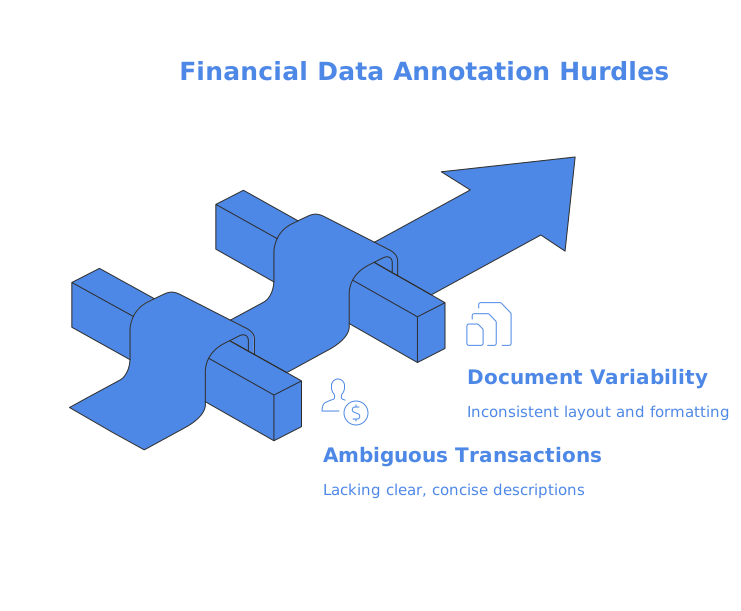
Financial data presents unique challenges due to its complexity, variability, and sensitivity. Annotators must manage diverse formats, ambiguous entries, and evolving industry requirements. These challenges require training, detailed guidelines, and structured quality checks to ensure consistent outputs.
Ambiguity in Transaction Context
Transactions often lack clear descriptions, requiring annotators to infer context through merchant data, transaction patterns, or associated metadata. Maintaining consistency across ambiguous cases demands well-defined rules that help annotators categorize entries accurately. Tutorials from market-data platforms such as Refinitiv illustrate how contextual metadata improves financial classification tasks.
Document Variability
Financial documents vary in layout, format, and quality. Scanned documents may include noise or formatting distortions. Annotators must identify relevant fields even when visual cues are limited. Guidelines must explain how to handle partial visibility, inconsistent templates, or overlapping data entries.
Designing Annotation Guidelines for Finance Assessment
Strong annotation guidelines help teams maintain consistency across large datasets. These guidelines define categories, clarify ambiguous cases, and ensure that annotations align with model objectives. Finance assessment requires especially careful planning because downstream models must remain explainable and auditable.
Defining Standard Label Categories
Label categories may include specific transaction classes, document field types, or risk indicators. Clear definitions help annotators navigate complex datasets and reduce disagreements. Guidelines may include visual examples and textual explanations to standardize how annotators interpret financial entries.
Quality Assurance Practices
Quality assurance workflows validate that annotations follow established guidelines and remain consistent across contributors. Reviewers analyze samples from each batch and correct mistakes that could bias the model. Multi-stage QA allows teams to catch errors early and maintain dataset stability across long-term projects.
How Models Learn From Finance Assessment Datasets
Machine learning models analyze annotated datasets to learn relationships between variables, detect patterns, and make predictions. Finance assessment models rely on these datasets to evaluate risk, detect anomalies, or interpret documents.
Learning Relationships and Patterns
Models learn relationships between labeled features and outcomes such as risk scores or classification categories. Annotated examples help models identify how variables interact and which patterns correlate with positive or negative outcomes. This learning process influences model decisions during real-world deployment.
Calibrating Outputs
Models use annotated ground truth to calibrate outputs and balance false positives with false negatives. Calibration routines help ensure that predictions operate within acceptable tolerance levels for financial decisions. Because financial decisions have material consequences, calibrated outputs reduce uncertainty and improve trust in AI-driven workflows.
Evaluating Finance Assessment Models
Evaluating finance assessment models requires test datasets that reflect real-world diversity. These datasets include legitimate transactions, edge cases, and confirmed anomalies. Evaluation metrics examine accuracy, recall, precision, and consistency across populations.
Cross-Domain Testing
Models must perform reliably across different customer groups, data sources, and transaction types. Testing across domains helps identify weaknesses and uncover potential biases. Institutions such as the Bank of England publish datasets and statistical frameworks that researchers use to benchmark financial systems under multiple conditions.
Monitoring Drift and Updating Datasets
Financial environments evolve due to market changes, new merchant types, or emerging fraud tactics. Models must be monitored for performance drift and retrained with updated annotations as these changes occur. Continuous dataset updates ensure that models remain aligned with operational realities.
Applications of Annotated Data in Finance Assessment
Annotated datasets enable numerous applications across risk evaluation, compliance, fraud detection, and customer onboarding. Each application benefits from consistent labeling and clear interpretation of financial variables.
Risk Evaluation and Underwriting Automation
Annotated datasets support automated underwriting systems by enabling models to evaluate borrower profiles and documentation quickly. These systems compare extracted document fields with transaction histories or reported income, improving assessment accuracy. When supported by structured datasets, underwriting models reduce manual workloads and increase decision consistency.
Fraud Detection and Compliance Monitoring
Annotated transaction datasets help institutions identify suspicious activity and comply with regulatory requirements. Compliance frameworks from organizations such as FINRA provide guidance on handling financial data responsibly and maintaining transparent audit trails. Annotated data supports these workflows by enabling accurate classification and anomaly detection.
Future Directions in Finance Assessment Annotation
Emerging technologies and data sources will influence how finance assessment datasets evolve. Improved extraction tools, continuous learning systems, and multimodal annotation strategies will strengthen the reliability of financial AI models.
Self-Supervised and Hybrid Annotation
Self-supervised learning reduces dependency on fully annotated datasets by allowing models to learn initial representations from unlabeled data. Hybrid strategies combine human annotation with automated suggestions, improving scalability while maintaining accuracy. These approaches will support larger, more diverse finance assessment datasets.
Multimodal Data Integration
Combining text, numerical data, and transactional sequences enables richer modeling. Future datasets will likely incorporate conversational interactions, customer support transcripts, and additional metadata to create more comprehensive financial profiles. Annotators will play an important role in structuring these new data sources.
If You Are Developing Finance Assessment Models
Building reliable finance assessment systems requires structured, high-quality annotated datasets. If you are preparing a risk model, fraud detection workflow, or financial document automation project, the DataVLab team can help design and manage annotation pipelines that strengthen model accuracy and ensure audit-ready datasets. Share your goals, and we can explore how to support your financial AI initiatives with dependable training data.
How does Labeled data power Risk, fraud analysis, and decision automation?
Data annotation for finance assessment provides the structured datasets required to train models that support risk evaluation, fraud prevention, underwriting automation, and document intelligence. This article explains how labeled data enables financial institutions to analyze complex inputs, classify transactions, and interpret documents with consistency.
What does the article explain about why finance assessment requires High-Quality annotation?
Finance assessment involves sensitive decisions that must be reliable and explainable. Models assess borrower characteristics, analyze transaction histories, identify anomalies, and evaluate documentation. Without carefully annotated datasets, these models struggle to distinguish normal patterns from risky signals.
What does the article explain about how financial institutions use annotated data?
Annotated datasets enable a wide range of models that assist with finance assessment. These applications rely on consistent training examples that reflect real-world financial interactions. As institutions integrate machine learning into their decision processes, annotated data supports more efficient, traceable, and accurate assessment workflows.
What does the article explain about what a finance assessment dataset contains?
A finance assessment dataset typically includes labeled examples of transactions, documents, numerical records, and customer interactions. These datasets contain structured entries such as numerical fields and unstructured content such as scanned documents or free-text notes. The diversity of data sources requires annotation workflows that combine domain expertise with consistent labeling rules.
What is involved in designing annotation guidelines for finance assessment?
Strong annotation guidelines help teams maintain consistency across large datasets. These guidelines define categories, clarify ambiguous cases, and ensure that annotations align with model objectives. Finance assessment requires especially careful planning because downstream models must remain explainable and auditable.
What are the main use cases for Data annotation for finance assessment?
Annotated datasets enable numerous applications across risk evaluation, compliance, fraud detection, and customer onboarding. Each application benefits from consistent labeling and clear interpretation of financial variables. Annotated datasets support automated underwriting systems by enabling models to evaluate borrower profiles and documentation quickly.